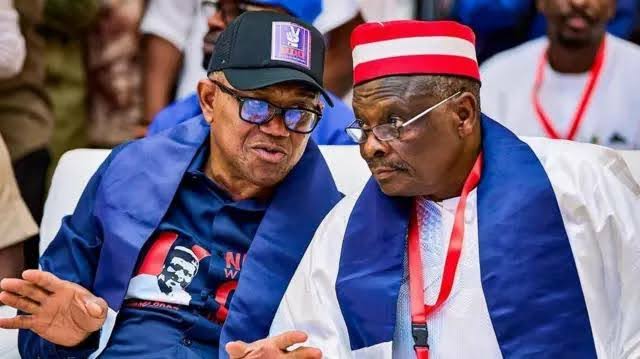
Kwankwaso defends Obi, says Shettima was wrong over ‘bogus statistics’ remark
Rabiu Kwankwaso, vice-presidential candidate of the Nigeria Democratic Congress (NDC), has defended the party’s presidential candidate, Peter Obi, following Vice-President Kashim Shettima’s criticism of his statistics and economic proposals.
Kwankwaso said Shettima was wrong to describe Obi as a master of bogus statistics, arguing that most of the figures cited by the former Anambra State governor were correct.
The NDC vice-presidential candidate spoke on Thursday during an interview on Channels Television while responding to the vice-president’s remarks.
“What else would you expect him to say?” Kwankwaso asked.
He said he regularly listened to Obi’s speeches and took time to verify the statistics he presented.
“As far as I’m concerned, most of the figures he was reeling out were correct,” he said.
Kwankwaso acknowledged that Obi, like other individuals, could make mistakes but described the disputed claims as potentially resulting from a slip of the tongue.
“But for him to come and make that statement, I don’t think he was correct,” he added.
The former Kano State governor also praised Obi’s knowledge of development statistics, describing it as a valuable quality for a presidential candidate.
He said Obi was familiar with statistics relating to Nigeria and other parts of the world, including Europe and Asia.
“I am happy that our presidential candidate is somebody who is conversant with the statistics not only in this country but all over the world, in Europe, in Asia, everywhere. And I think that is a good thing,” Kwankwaso said.
Shettima had criticised Obi on Wednesday, accusing him of making an unsupported claim that he won the 2023 presidential election.
The vice-president said Obi had gone beyond his mastery of philosophy to make what he described as a bogus claim about the election outcome without providing evidence to support it.
Shettima also described the Labour Party’s 2023 presidential candidate as “the master of bogus statistics and incoherent economic prescriptions”.
He further criticised the adoption of foreign policies without considering a country’s peculiar circumstances, comparing the approach to trying to fit a garment designed for a smaller body onto a much larger one.