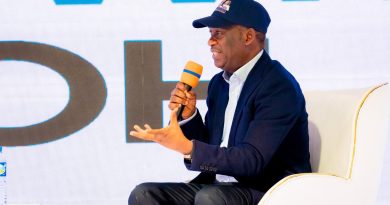
Don’t travel to Libya, hardship worse there, Soyombo warns Nigerians
Investigative journalist and Foundation for Investigative Journalism founder, Fisayo Soyombo, has warned Nigerians seeking to escape economic hardship through irregular migration that they may face even more difficult conditions in Libya.
Soyombo gave the warning during an interview on ARISE News on Sunday while discussing his 47-day undercover journey from Kano through Niger to Tripoli, where he documented the experiences of migrants travelling along the Sahara Route.
He said some Nigerians experiencing economic deprivation may view migration as an escape without fully understanding the conditions awaiting them in Libya.
“You know, when you are trying to escape economic deprivation, you think that any other option is good. The options in Libya are worse,” Soyombo said.
According to him, some Nigerians who reach Libya become stranded after running out of money and are forced to take up jobs to survive while saving for another attempt to cross into Europe.
“What happens a lot of time is, they get to Libya, they realise they can’t cross. They are stuck. They run out of funds. Then they have to go into many jobs to at least be able to eat. Then they start saving to cross,” he said.
Soyombo also said irregular migrants in Libya face difficulties accessing conventional financial services and may be vulnerable to robbery because they have to keep their money in cash.
“But don’t forget, you’ve gone into Libya illegally because Libya already criminalised irregular migration. You can’t open a bank account. So you keep cash. Anyone can rob you,” he said.
He further described the conditions faced by migrants who take up agricultural work in the desert, saying they may be exposed to extreme temperatures and, in some cases, may not receive payment for their labour.
“The Nigerians who are in Libya are farming. Do you know the temperatures in Libya? It’s a desert. The hottest Nigerian state I’ve been to is probably Yobe,” Soyombo said.
He added, “The Agadir that was the start of the desert was like 20 degrees centigrade to 32 degrees centigrade. In the desert, you are talking temperatures of 40 and more as you go to farm.”
Soyombo also recounted an incident involving migrants who, according to him, were taken to work on a farm and were not paid.
He said some migrants were taken to the farm after an Arab man stopped them at a village.
“The guys that were not fast, he conscripted them to the farm. They worked for like three hours in this scorching sun. And he didn’t pay them a dime,” he said.
According to Soyombo, the migrants were later robbed of their money and taken back to work.
“Robbed them, took their cash, took them to the farm and he didn’t pay them a dime. Who were they going to complain to? He robbed them and then he enslaved them,” he said.
Soyombo said he did not blame Nigerians who had travelled to Libya, noting that some migrants he encountered told him they would not have made the journey had they known the difficulties ahead.
“I don’t blame them, I will never sit anywhere and blame anyone who has gone to Libya. Because on that trip, a lot of migrants told me, oh, if I knew I would suffer this much, I wouldn’t come,” he said.
He said his investigation was intended to provide first-hand information about the dangers associated with the journey and help Nigerians make more informed decisions.
“So we have to help people to let them know how that Europe they want to get is extremely difficult,” Soyombo said.
He also said the journey was more unpredictable than many migrants realise, despite preparations and estimates about how long it could take.
“So for instance, the first thing is that you can never predict that journey. I spent six months preparing for this project. I was told to budget 30 days. I ended up spending 47 days,” he said.
Soyombo said many migrants embark on the journey without adequate information about the risks.
“So they embark on that journey not knowing how dangerous it is. It’s far more dangerous than… It’s not a journey I would wish on my enemy,” he said.
He added that documenting his experience was one way of providing Nigerians considering the route with information about what they could encounter.
“And for me, the most straightforward way to help them is to say, this journey you’re about to go through, I went through it and have documented it. These are photos, these are videos,” Soyombo concluded.