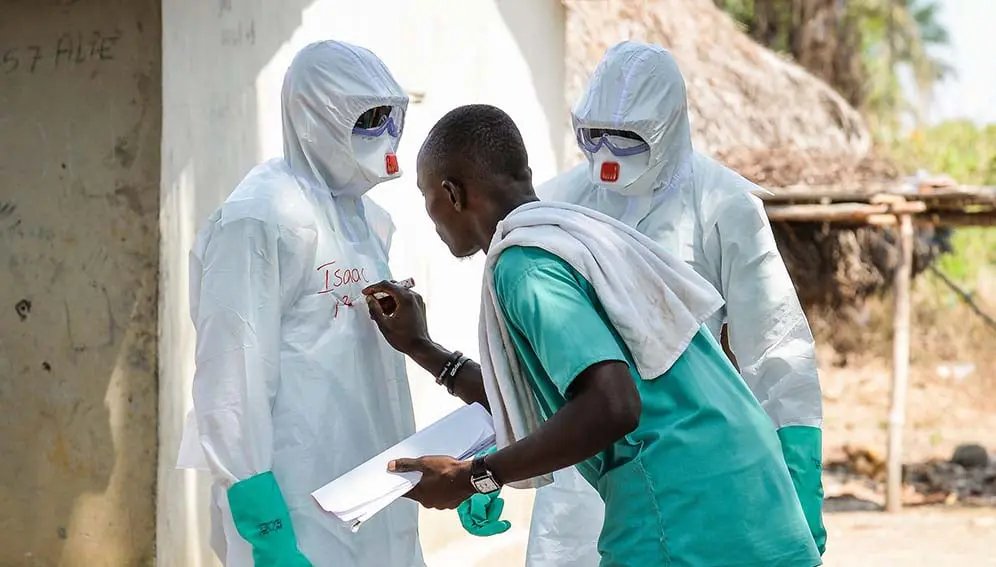
Ebola Outbreak Not Yet Under Control, Africa CDC Warns
The Africa Centres for Disease Control and Prevention (Africa CDC) has warned that the Ebola outbreak affecting parts of the continent is not yet under control, citing rising infections, deaths and concerns over continued transmission.
Jean Kaseya, director-general of Africa CDC, disclosed this on Friday during an interview on Morning Brief, a Channels Television programme.
Kaseya said the assessment followed a virtual ministerial meeting held on October 28, which brought together more than 42 ministers and over 600 participants, including representatives of international organisations and development partners.
He said the meeting reviewed the outbreak’s trajectory and the latest epidemiological data, which showed that transmission remained a major concern.
“We analysed the data and we saw that the outbreak is not yet under control,” he said.
According to Kaseya, more than 10,200 confirmed cases and 5,000 deaths have been recorded across the continent since the outbreak began.
“We have achieved what is a number of 10,000 people confirmed cases in DRC and also, if we put together, it’s more than 10,200 confirmed cases across the continent,” he said.
“We also saw that we have more than 5,000 people already passed on due to this outbreak.”
He also noted that the geographical spread of the outbreak was changing, with the epicentre shifting.
The outbreak, caused by the Bundibugyo strain of the Ebola virus, has affected several African countries, including the Democratic Republic of the Congo (DRC), Kenya and Nigeria.
The DRC remains the worst-affected country, accounting for the overwhelming majority of infections and deaths. According to the European Centre for Disease Prevention and Control, the country had recorded 10,193 confirmed cases and 4,960 related deaths as of October 28.
Kenya has also reported nine confirmed cases, including two deaths, following an imported infection linked to the DRC.
In Nigeria, the first Ebola case in more than a decade was confirmed on October 20 after a 42-year-old Swiss woman tested positive for the Bundibugyo strain in Abuja.
The patient, who had travelled from Uganda to Nigeria, was isolated and treated by Nigerian health workers before being medically evacuated to Switzerland on October 26 for further treatment after her condition stabilised.
Her husband, who was identified as a close contact, was also evacuated to Switzerland.
Following the evacuation, Mohamed Janabi, WHO regional director for Africa, said Nigeria had no confirmed Ebola cases.
However, the World Health Organisation clarified that the development did not mean Nigeria had been officially declared Ebola-free.
The organisation explained that health authorities were still monitoring individuals who had contact with the patient and that Nigeria must complete the required 42-day monitoring period before an official declaration could be made.
In its October 29 situation report, the Nigeria Centre for Disease Control (NCDC) said 62 contacts linked to the index case had been identified and were being monitored.
The agency added that no new contacts or symptomatic contacts had been identified in the preceding 24 hours.
The outbreak has heightened concerns over cross-border transmission and the capacity of African countries to contain infectious diseases amid increasing movement of people across the continent.