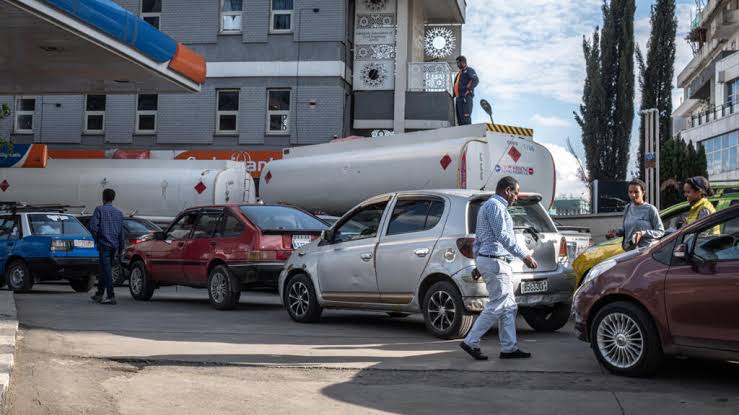
Ethiopia sends non-essential public workers on leave amid fuel shortage
The Ethiopian government has directed public institutions to place non-essential workers on annual leave as part of efforts to ease a worsening fuel shortage disrupting transportation nationwide.
The crisis, worsened by the ongoing conflict in Iran, has led to long queues at fuel stations, often involving hundreds of vehicles, including trucks, buses, and cars.
Authorities say the temporary leave policy is aimed at reducing fuel consumption and easing pressure on the transport system.
In the long term, Ethiopia plans to transition to electric vehicles (EVs). A document from the ministry of finance and the Ethiopian Investment Commission outlines a strategy to replace the country’s public vehicle fleet with EVs by 2030.
The government is also encouraging transport operators to adopt compressed natural gas (CNG) as an alternative to diesel.
Ethiopia joins a growing list of countries implementing energy-saving measures as tensions in the Middle East continue to strain global energy supply.
Recently, Sri Lanka instructed local authorities to switch off street lights when not needed, reduce air conditioning use, and limit elevator operations.
Other countries, including India, Myanmar, Thailand, the Philippines, Zimbabwe, South Sudan, and Pakistan, are also adopting similar measures to manage the energy crisis.