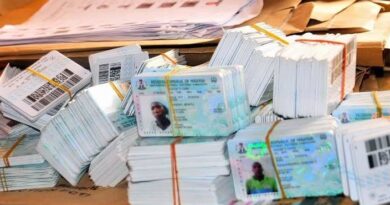
INEC Flags 268 Voter Records Over Suspected AI-Generated Photos, Irregularities
The Independent National Electoral Commission (INEC) has flagged 268 records in its preliminary Register of Voters over suspected artificial intelligence-generated photographs and other irregularities as part of efforts to sanitise its database ahead of the 2027 general elections.
The commission’s Director of Information and Communication Technology, Lawrence Bayode, disclosed this during an appearance on Channels Television’s Sunday Politics, explaining that the Automated Biometric Identification System (ABIS) identified the questionable records for further investigation.
Bayode said the commission was reviewing all 268 records flagged by the system to determine those containing AI-generated photographs and other irregularities.
“What we are currently doing now is looking at all these 268 records that ABIS already flagged as AI-generated or even something of irregularities,” he said.
He explained that some individuals allegedly exploited a special registration option designed for persons with disabilities, particularly those with incomplete or missing fingers, to create questionable voter profiles.
According to him, the commission had commenced the process of removing records confirmed to be fraudulent or irregular from the preliminary register.
“Those that we have seen, we are cleaning up,” he said.
However, Bayode clarified that voters whose genuine photographs were merely enhanced using artificial intelligence applications would not be removed from the register.
He distinguished between photographs of actual individuals improved with AI-powered phone applications and images entirely generated by artificial intelligence.
“Those that we know it is the AI on the phone that helped enhance their pictures, we can’t exclude such people because it was the AI on the phone that does that.
“Such people will still be on the register but those AI-generated, those photographs, all these will be removed. We are already looking at them,” he added.
The development followed the publication of INEC’s preliminary Register of Voters on its website on October 26, which generated public concerns after screenshots showing suspicious photographs attached to voter records circulated on social media, particularly in parts of Edo State.
The controversy also raised questions about alleged duplicate registrations, the inclusion of deceased persons in the register and complaints by some registered voters that their details were missing from the online database.
The allegations attracted reactions from political leaders, civil society organisations and other Nigerians, who demanded explanations from the electoral commission over the credibility of the voter registration process.
The Nigeria Democratic Congress vice-presidential candidate, Rabiu Kwankwaso, called for a thorough, transparent and independent investigation into the alleged irregularities.
In a statement shared on his X account, Kwankwaso said Nigerians deserved more than assurances from INEC, insisting that the findings of the investigation should be made public and anyone found culpable held accountable.
He also called for the verification of questionable entries and investigations into possible duplicate or artificial identities to prevent eligible voters from being disenfranchised.
Similarly, political economist Pat Utomi expressed concern over the development, saying the discovery raised serious questions about the commission’s verification and accountability mechanisms.
Utomi, in a post on X, warned that the presence of AI-generated photographs in a register meant to support Nigeria’s democracy could undermine public confidence in the electoral process.
The National Coordinator of the Obidient Movement, Dr Moses Paul, also demanded explanations from INEC, questioning how the suspected AI-generated photographs found their way into the voter register.
Paul maintained that Nigerians would not accept silence or secrecy over an issue he said could threaten confidence in democratic institutions.
Also reacting, the Director of the Policy and Legal Advocacy Centre, Clement Nwankwo, questioned the credibility of the voter register and warned that the alleged irregularities could affect the integrity of the 2027 general elections.
Speaking during an interview on ARISE News, Nwankwo expressed concern over the increase in the number of registered voters from more than 90 million to 103 million, questioning the accuracy of the figures and the verification procedures adopted by the commission.
He argued that the emergence of AI-generated information and photographs presented new challenges for the electoral process, urging INEC to strengthen its verification mechanisms.
Nwankwo also called for improved communication between the commission and political parties, warning that shortcomings in voter registration and polling unit transfer processes could disenfranchise eligible voters.
Meanwhile, INEC had earlier defended the publication of the preliminary register, explaining that the online version released on October 26 was the same document physically displayed at Registration Areas across the country between October 9 and 15.
In a statement issued by the Chairman of its Information and Voter Education Committee, Mohammed Kudu Haruna, the commission said the online publication did not capture all the data-cleanup activities already underway.
It stressed that the preliminary register was not the final certified document, explaining that the Display, Claims and Objections exercise was designed to allow members of the public to identify inaccuracies, report questionable entries and request corrections before certification.
The commission also said it was investigating the circumstances surrounding the suspicious photographs, including possible technical and procedural lapses, and would take appropriate action based on verified findings.
INEC Chairman, Prof. Joash Amupitan, also assured Nigerians that the commission was examining the records and would implement corrective measures where necessary.
The electoral body is expected to conclude the verification, adjudication and data-cleanup processes before certifying the final Register of Voters on December 15, 2026.