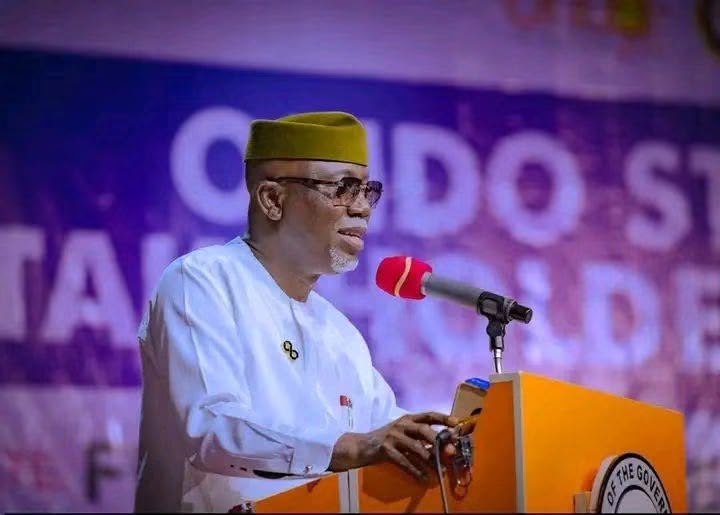
Flooding in Ondo State: Between Nature, Human Actions and Gov. Aiyedatiwa’s Response
By Olubunmi Ololajulo.
There is perhaps no environmental challenge that tests government, communities and citizens quite like flooding. When the rain falls heavily and streets, homes, shops and roads begin to disappear under water, the first question people understandably ask is: What is government doing about it?
In Ondo State today, that question deserves an honest answer. The reality is that flooding is a serious challenge across several parts of the state. It has disrupted businesses, damaged property, affected movement and caused genuine anxiety among residents. For those whose homes or means of livelihood have been affected, explanations are not enough. What matters is action.
In respect to the foregoing, the administration of Governor Lucky Orimisan Aiyedatiwa has approached the issue from two fronts: intervention where flooding occurs and prevention before the next rainfall comes. Flooding in Ondo State does not have one single cause. Some parts of the state are naturally vulnerable because of their terrain, proximity to rivers and the Atlantic coastline, low-lying settlements and the intensity of seasonal rainfall. The 2026 Annual Flood Outlook released by the Nigeria Hydrological Services Agency identified Ondo among the states facing significant flood risks this year.
The riverine communities of Ilaje and Ese-Odo, for instance, face environmental realities that cannot simply be solved by opening a drainage channel. Sea incursion, coastal erosion, rising sea levels and tidal influences have created a much larger ecological challenge. At Ayetoro in Ilaje, the scale of the environmental crisis has become so serious that the state government has been seeking broader national and international intervention. In many urban communities, human activities are making a difficult natural situation worse: Blocked drainage channels, indiscriminate dumping of refuse, construction on waterways, illegal structures and undersized canals can prevent rainwater from following its natural course. In some locations, what begins as heavy rainfall becomes a flood disaster because the water has nowhere to go.
Let me state unequivocally: Governor Aiyedatiwa has not treated flooding as an issue to be discussed only when the rain comes. His administration began targeted flood-control interventions before the current peak of the rainy season, with the Governor directing officials responsible for erosion and flood control to remain in the field and address vulnerable locations.
In February 2026, the Governor ordered intensified action against flooding across the state, with government returning to critical locations where drainage and channelisation works had already begun. Amphibious machines were deployed to vulnerable areas, including Ondo town and Odigbo, with additional intervention planned for Akure South Local Government Area. This approach reflects a simple philosophy: flood control should not begin after people’s homes have been submerged. It should begin before the water arrives. That philosophy is also consistent with the Federal Government’s 2026 flood outlook, which emphasised the importance of early action, preparedness and community-level forecasting rather than waiting for disasters to occur.
One of the most important components of flood management is infrastructure. The Ondo State Commissioner for Infrastructure, Lands and Housing, Engr. Abiola Olawoye, has been overseeing an administration-wide infrastructure programme that includes road construction, drainage-related interventions and other works designed to improve movement and urban resilience. The State Executive Council has also approved canalisation works in Ilaje Local Government Area and concrete walkways in coastal communities, recognising the special infrastructural needs of Ondo’s riverine settlements: This is particularly significant because infrastructure and flood management cannot be treated as separate issues.
Across the state, roads and infrastructure projects have continued in urban and rural communities, while specific flood-control and canalisation interventions are being pursued in areas identified as vulnerable. The 2026 state budget also contains specific provisions for erosion-control infrastructure, drainage and channelisation interventions in locations including Igbokoda, Irele, Akure, Ikare-Akoko and Ore. In other words, the response is not simply about clearing yesterday’s floodwater. It is also about improving the infrastructure that determines where tomorrow’s water will go.
However, One cannot effectively fight flooding while allowing drainage channels to become dumping grounds.
The ministry of environment has therefore continued to push environmental sanitation, waste-management compliance and public awareness, while warning residents against practices capable of obstructing waterways. The Ondo State Commissioner for Environment, Dr. Tob Loko has maintained a zero-tolerance position toward environmental abuse, including indiscriminate disposal of waste. The administration’s environmental policy also places responsibility on residents and businesses to properly manage the waste they generate.
The state has also moved toward stronger enforcement, including the activation of mobile courts for environmental violations and warnings that people who obstruct waterways can face sanctions. Also,the Gov. Lucky Aiyedatiwa-Led administration is also looking beyond immediate flooding to the larger question of climate resilience. In 2025, Governor Aiyedatiwa approved the development of a climate-change policy and circular-economy roadmap, signalling an attempt to address environmental challenges from a broader and longer-term perspective and in the coastal communities, the Governor has openly acknowledged that the environmental crisis is bigger than what the state can solve alone. At the 2026 World Environment Day event in Ayetoro, his administration through the Ondo State Oil Producing Areas Development Commission called for urgent wider intervention over sea incursion and the growing vulnerability of coastal communities. That is leadership that recognises the limits of state resources while still accepting responsibility to act.
Perhaps one of the less visible but important aspects of the government’s flood response is the work being coordinated by the Governor’s Special Assistant on Erosion Control and Flood-Related Matters, Engr. Elisha Ebijimi. His role has taken him directly into flood-prone communities, where the focus has been on channelisation, drainage expansion, clearing waterways and identifying obstructions to the natural flow of water. Some of the works have involved dramatically expanding existing channels. In one Akure intervention, a canal that had previously been about four metres wide was being expanded substantially, with some sections reaching up to 25 metres wide and four metres deep. Plans were also made for concrete reinforcement, with World Bank support identified for more permanent canal works.
In July 2026, government enforcement teams moved against illegal structures along Oyemekun Road in Akure. Following the removal of the obstruction, plans were announced to expand the drainage channel and construct concrete retaining walls to guide water along its natural course. Similar enforcement was scheduled to extend to other vulnerable locations in Akure and subsequently Ondo town. These are the kinds of interventions that may not always make the news.
It is pertinent to note that the flooding challenge is not confined to one part of the state. Local Government Areas affected so far include: Odigbo, Okitipupa, Ilaje, Ese-Odo, and Irele but during the July 2026 torrential rainfall, for example, parts of Ondo West, Akure South and Owo Local Government Areas were also flooded.
It would also be misleading to describe every flood incident in Ondo State as a failure of government. It would equally be misleading to pretend that every flood is an unavoidable act of nature. Heavy rainfall is a natural trigger: The state’s coastal geography and riverine communities create additional exposure. Climate change is also contributing to changing rainfall patterns and environmental pressures. Also, when drains are blocked with refuse, when waterways are narrowed by illegal development, when buildings are erected on natural drainage paths and when construction materials are dumped on roads and gutters, the consequences of rainfall become more severe.
Government has a responsibility to provide infrastructure and enforce environmental and physical-planning laws. Citizens also have a responsibility not to destroy the same infrastructure they demand from government. Flood control, therefore, cannot be a government-only project.
It must be a partnership between government, communities, traditional institutions, businesses, landlords, developers and residents. It is not a one-day project. It is a continuous responsibility. As the rains continue, the task before government is clear: keep the waterways open, strengthen the infrastructure, enforce the law, protect vulnerable communities and, most importantly, keep listening to the people.
From the expansion of canals to the deployment of amphibious equipment; from environmental enforcement to the removal of structures obstructing waterways; from infrastructure and drainage interventions to the pursuit of climate-resilience measures; from interventions in Akure to works in Ilaje, Ese-Odo, Odigbo and other vulnerable communities, there has been a sustained attempt to confront the problem.
Governor Lucky Orimisan Aiyedatiwa deserves commendation for confronting Ondo State’s flooding challenge with responsibility, compassion and determination. While government cannot stop the rain, his administration remains committed to acting early, protecting vulnerable communities and reducing the impact of flooding across the state. The work continues, with a clear resolve to build a safer, stronger and more resilient Ondo State.
Olubunmi Ololajulo is Special Assistant on New Media to the Governor of Ondo State