Sunrise promoter transferred $500,000 to Atiku’s wife during Mambilla talks
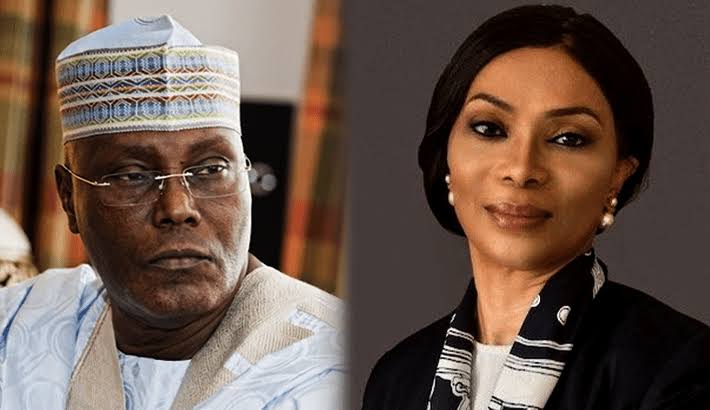
Leno Adesanya, promoter of Sunrise Power and Transmission Company Limited, has told an international arbitration tribunal that the $500,000 he transferred to Jennifer Douglas, the former wife of ex-Vice-President Atiku Abubakar, in January 2003 was part of a foreign-exchange transaction carried out for Atiku.
The payment was made on January 30, 2003, less than four months before Sunrise was purportedly awarded a build-operate-transfer contract for the Mambilla hydropower project. It was transferred through China Castle Investments Limited, an offshore company controlled by Adesanya.
Details of the transaction and Adesanya’s explanation are contained in the final award issued by a three-member International Chamber of Commerce tribunal in the arbitration between Sunrise and the Federal Republic of Nigeria.
The tribunal rejected Sunrise’s claims against Nigeria and ordered the company and Adesanya to reimburse the country for most of the legal costs incurred during the proceedings.
During the arbitration, Nigeria alleged that the $500,000 payment to Douglas was connected to the disputed award of the Mambilla contract.
Sunrise and Adesanya denied the allegation, maintaining that the payment had nothing to do with the project.
Adesanya said he had operated a bureau de change business through Moneyline Ventures Limited and that the money sent to Douglas’s Citibank account in the United States represented dollars purchased for Atiku with naira.
“I confirm that I made a transfer of $500,000 to the Abubakars through my company China Castle Investments Ltd in early 2003,” Adesanya said in his fourth witness statement, according to the award.
Under cross-examination, he also acknowledged transferring the money to Douglas.
However, the tribunal said Adesanya did not produce documents showing the underlying naira payment, the exchange rate applied, instructions from Atiku or his aides, correspondence concerning the transaction, or any record establishing its commercial purpose.
Adesanya said discussions relating to the transaction were oral and that, more than two decades later, he no longer had access to any written exchanges that might once have existed.
Neither Atiku nor Douglas gave evidence during the arbitration.
The tribunal said Sunrise and Adesanya did not submit a witness statement or declaration from either of them to corroborate the foreign-exchange explanation.
According to the award, Adesanya said he tried to secure Atiku’s testimony but the former vice-president was reluctant to become involved in proceedings concerning former President Olusegun Obasanjo.
Adesanya initially suggested that Atiku, through his lawyers, had confirmed that the payment was a foreign-exchange transaction. During cross-examination, however, he said the explanation had been relayed to him by “Dr Ndukwe”, whom he identified as Atiku’s medical doctor, while a later confirmation came through lawyers.
Pressed on whether the confirmation actually originated from Atiku, Adesanya described that as his “logical assumption”, saying he did not believe Atiku’s lawyers would have supplied the information without consulting him.
The tribunal treated the account cautiously, noting that Adesanya produced no correspondence, telephone records or other evidence of his alleged contacts with Atiku’s counsel, Ndukwe or the former vice-president’s aides.
why douglas did not testify
Adesanya also explained why he was unable to obtain evidence from Douglas.
During the hearing, he said she and Atiku had gone through a difficult divorce and that she had fallen out with him because he opposed the separation and supported Atiku and another wife.
“She would not even pick my call,” Adesanya was quoted as saying.
The tribunal observed that this account conflicted with his fourth witness statement, in which he said he remained friends with Douglas. He had also described her as a close friend and his first girlfriend in high school.
The award also referred to a 2010 report by the United States Senate Permanent Subcommittee on Investigations, which examined offshore transfers into Douglas’s US accounts. The report said that, as banks questioned the payments, she maintained that the funds came from her husband and professed little familiarity with the offshore companies that transmitted them.
The tribunal said the absence of corroborating evidence, together with inconsistencies in Adesanya’s testimony, meant it could not accept his explanation that the $500,000 was a foreign-exchange transfer for Atiku.
It also found that Adesanya failed to prove that Moneyline held a bureau de change licence at the time.
Although he offered during the hearing to obtain the licence from his company secretary, no copy was subsequently presented to the tribunal.
The tribunal said that even proof of a Moneyline licence would not have resolved the issue because the money was transferred by China Castle, not Moneyline.
Adesanya accepted under cross-examination that China Castle was not licensed to conduct foreign-exchange transactions and that such transactions did not fall within its stated corporate purposes.
negotiations preceded the payment
The tribunal examined the payment against the background of negotiations for the Mambilla project, which had started nearly two years earlier.
On September 12, 2001, Sunrise and North China Power Engineering Company met officials of the National Electric Power Authority and expressed interest in participating in the project.
Sunrise was incorporated in Nigeria on October 9, 2001, to identify investment opportunities principally in the power sector. Adesanya, his wife and Lenoil Holdings Limited, another company associated with him, were its initial shareholders.
Six days after its incorporation, North China Power Engineering Company and Lenoil Holdings met to discuss power-sector projects, including Mambilla.
On October 18, Sunrise wrote separately to Obasanjo and Atiku, informing them of its interest, with its Chinese partner, in developing the hydropower project.
Atiku and his team met representatives of Sunrise and the Chinese company on November 13.
According to minutes cited by the tribunal, the then vice-president said the project was expected to cost about $6 billion, while the companies reaffirmed their interest in developing it.
Sunrise and the Chinese firm submitted a proposal to the technical committee of the Federal Ministry of Power and Steel on December 12, 2001.
Sunrise sought government participation in the ownership of the project, arguing that it would strengthen the confidence of its foreign partner to invest more than $4 billion.
The company also requested a waiver of the mandatory $500,000 processing fee required by NEPA.
In January 2002, Obasanjo and Olusegun Agagu, then minister of power and steel, invited Sunrise to preliminary discussions. The meetings took place on January 21 and 24.
On March 1, Agagu informed the company that Mambilla would be privately financed and that the federal government was considering a minority equity interest of no more than 25 percent.
The minister also said an initial $100,000 tranche of the $500,000 processing fee should be put in escrow to cover a non-refundable consultancy charge.
Atiku subsequently led a federal government delegation to China in July 2002. The delegation included Aliyu, then minister of state for power and steel, and Adesanya.
During the trip, Nigerian officials and Chinese companies signed a memorandum of understanding covering seve