
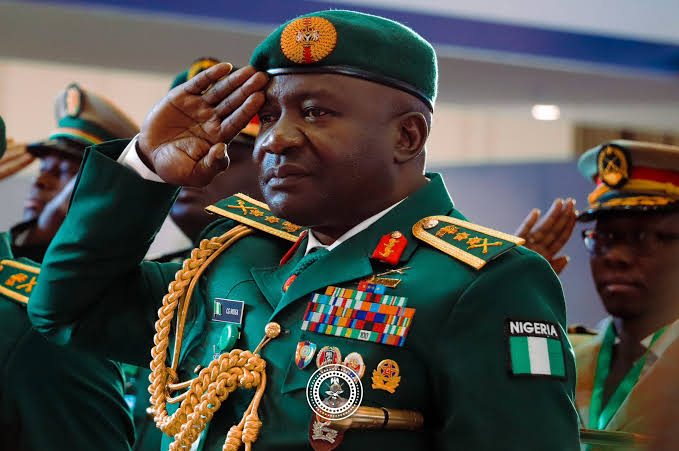
Nigeria’s porous borders driving insecurity, says Christopher Musa
Christopher Musa, Nigeria’s minister of defence, has blamed the country’s porous borders for worsening insecurity, saying they allow terrorists, bandits and kidnappers to move freely across the country.
Speaking in an interview with the BBC, Musa said the federal government is considering several measures, including the use of advanced technology and limited border walls, to curb illegal crossings.
“Porous borders are one of the main reasons for insecurity in Nigeria,” he said.
Musa noted that Nigeria shares over 4,000 kilometres of land borders, making it unrealistic to construct physical walls across all entry points. He added, however, that technology could be deployed to monitor movements and trigger alerts whenever illegal crossings occur.
According to him, countries with even longer borders have successfully adopted similar technological solutions.
The former chief of defence staff said the government plans to engage border communities to ensure residents understand their role in preventing terrorists from operating within their areas.
“Maybe we cannot have physical walls everywhere, but there is technology we can deploy systematically. Once someone crosses, an alarm is triggered and we take action,” he said.
Musa also stressed the need for awareness campaigns, urging border communities not to support terrorists in any form.
His comments come amid a wave of mass abductions in Niger, Kebbi and Kwara states toward the end of 2025.
On Christmas Day, the United States carried out air strikes on suspected hideouts of the Lakurawa terrorist group in Sokoto state. Musa said the strikes forced the group to flee into Niger Republic.
The defence minister dismissed claims that the Nigerian government pays ransom to bandits, saying kidnappers often abandon captives when pressured by the military.
“We do not approve ransom payments for any reason,” he said.
Musa also rejected allegations by United States President Donald Trump that Christians are being persecuted in Nigeria, noting that insecurity affects Nigerians regardless of religion.
“Nigerians are being killed. That is the bottom line,” he said.
“Our focus is to stop the killings, whoever the perpetrators or victims are.”


